
A mattress that smells of urine is one of those problems that looks solved long before it actually is. You scrub the spot, the stain fades, the room smells of cleaning spray for a day or two — and then, usually on the first warm humid night, the smell is back exactly where it was.
That is not bad luck and it is not your cleaning. It is chemistry. Urine leaves behind uric acid crystals that soap and water cannot dissolve, and those crystals sit deep in the foam waiting for moisture to reactivate them. Until they are broken down, the smell always returns.
This guide covers how to remove urine smell from a mattress properly: the step-by-step method for fresh accidents, what to do when the urine dried weeks ago, how to remove pee stains without bleaching the fabric, and the separate, harder job of removing cat pee from a mattress. It also covers what never to use, because two of the most commonly recommended products make the problem permanent.
Why Urine Smell Keeps Coming Back
Urine is mostly water, and it carries urea, salts, bacteria and uric acid. When it dries, the water evaporates and the rest stays in the mattress.
Urea and the salts rinse out reasonably easily. Uric acid does not. It forms tiny crystals that bond to the fibres and foam, and they are not water soluble, which is why plain washing moves them around rather than removing them. They are also hygroscopic, meaning they draw moisture out of the air. On a humid night in Dubai, those crystals pick up enough moisture to release the smell all over again.
This explains the pattern almost everyone reports:
- The smell disappears after cleaning and returns a few days later.
- It is much worse in humid weather or when someone sleeps on the mattress.
- Air freshener works for an hour, then the smell is back underneath it.
- The stain is gone but the odour is not.
So the goal is not to mask the smell or even to clean the surface. The goal is to break down the uric acid, and that needs either an acid like white vinegar or, for stubborn and animal urine, an enzyme cleaner that digests the crystals.
What You Need to Remove Urine Smell from a Mattress
Everything here is available in any Dubai supermarket. You do not need a steam cleaner, and you should not use one.
- Clean dry towels or paper towels — several, for blotting.
- White vinegar — plain distilled, not malt or balsamic.
- Baking soda (bicarbonate of soda) — a generous amount, at least a full cup.
- A spray bottle for applying liquid in a fine mist.
- Washing-up liquid — a few drops only.
- 3% hydrogen peroxide — for yellow stains, on light mattresses only.
- An enzyme cleaner — essential for cat urine, useful for everything else.
- A vacuum with an upholstery attachment.
- A fan, which matters more than people expect.
One rule before you start: never soak a mattress. Liquid that reaches the core cannot evaporate out, and a damp mattress core in a humid climate grows mould far faster than it dries. Every step below uses the smallest amount of liquid that will do the job.
Step 1: Strip the Bed and Act Immediately
Speed matters more than technique. Urine that is still wet has not formed crystals yet, and a fresh accident dealt with in the first ten minutes often leaves no trace at all.
Pull off the sheets, the mattress protector and any bedding that has been touched, and get them straight into the washing machine on the hottest wash the labels allow. Add half a cup of white vinegar to the drum along with the detergent — it neutralises odour in fabric the same way it does in foam.
If the duvet or pillows are affected and cannot go in a domestic machine, they need a proper laundry service rather than a surface clean, which is what wash and fold laundry is for. Do not put them back on the bed until the mattress itself is finished and fully dry.
Step 2: Blot Up as Much Urine as You Can
Press a thick folded towel firmly down onto the wet area and hold it. Stand on it if you need to. The aim is to pull liquid up out of the foam, not to spread it across the surface.
Replace the towel as soon as it is damp and repeat until a fresh towel comes away almost dry. Expect to use several.
Do not rub. Rubbing drives urine deeper into the mattress and spreads a small circle into a large one. Blot straight down, lift straight up.
What if the urine has already dried?
Then there is nothing to blot, and you move straight to Step 3 — but you will need to work the area more than once. Dried urine means the uric acid crystals have formed, and a single pass rarely reaches all of them.
For anything older than a few days, use an enzyme cleaner rather than vinegar from the start. Vinegar neutralises odour on contact; enzymes actively digest the crystals, which is what an old stain needs. Plan on repeating the full process two or three times.
Step 3: Apply a Vinegar Solution
Mix equal parts white vinegar and cool water in a spray bottle, and add two or three drops of washing-up liquid. Shake it gently.
Mist the affected area until it is lightly damp — damp, not wet. You want the solution to reach as deep as the urine did and no deeper. Spray a little wider than the visible mark, because urine always spreads further under the surface than it shows on top.
Leave it to work for ten to fifteen minutes, then blot the area again with a dry towel to lift the solution and the dissolved residue back out.
How much vinegar is too much?
If the mattress feels wet rather than damp, you have used too much. Blot harder and give it longer under a fan before moving on. The vinegar smell itself is not a problem — it is sharp while wet and disappears completely as the mattress dries, taking the urine odour with it.
Step 4: Cover the Area in Baking Soda
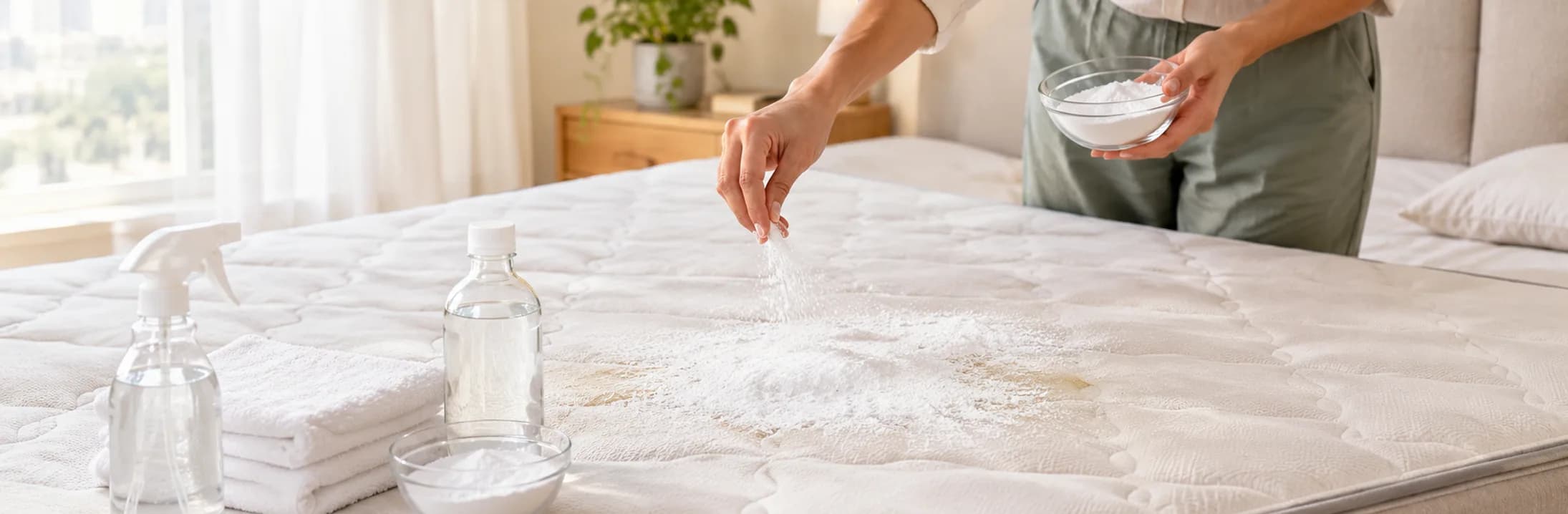
While the spot is still slightly damp, cover it in a thick, even layer of baking soda. Thick is the word that matters: a light dusting does almost nothing. You want the area white and completely hidden, using a full cup or more for a large patch.
The damp surface lets the baking soda draw moisture and dissolved odour compounds up out of the foam as it dries, which is the whole point. Dry baking soda sprinkled on a dry mattress only deodorises the surface.
Leave it for a minimum of eight hours. Overnight is good. A full twenty-four hours is better, and for an older stain, leave it longer. Keep pets and children off the bed while it sits.
Does baking soda remove urine smell on its own?
Partly, and not permanently. Baking soda is excellent at absorbing moisture and neutralising acidic odour in the air, so a mattress treated with baking soda alone will smell better for a while. But it does not dissolve uric acid crystals, so the source is still there and the smell comes back.
Baking soda is the drying and deodorising stage. Vinegar or an enzyme cleaner is the stage that actually removes the cause. Skipping either one is why most home attempts only half work.
Step 5: Vacuum Thoroughly
Once the baking soda is bone dry and slightly crusty, vacuum it up with the upholstery attachment. Go slowly and overlap your passes. Work the nozzle in several directions rather than one, because baking soda settles into the quilting and the seams and a quick pass leaves most of it behind.
Now smell the area closely, with your face near the mattress. If there is any urine odour left at all, repeat Steps 3 to 5. A second round is normal, and a third is not unusual on a stain that had dried.
Step 6: Dry the Mattress Completely
This step gets skipped more than any other, and in Dubai it is the one that decides whether you have fixed the problem or created a worse one.
Stand the mattress on its side if you can, or at minimum pull it away from the wall and the bed base so air reaches both faces. Put a fan on it, pointed at the treated area, and leave it running for several hours. Run the air conditioning in the room, which dehumidifies as well as cools and speeds this up considerably.
Do not remake the bed until the area is dry to the touch and smells of nothing.
How long does a mattress take to dry?
With a fan and the AC running, four to eight hours for a lightly treated area. Without airflow, a day or more, and in a humid room it may never fully dry.
Direct sunlight is the traditional answer and it does work — UV is genuinely antibacterial — but on a Dubai balcony in summer it also collects dust in minutes. Indoors with a fan and AC is the better option here.
How to Remove Pee Stains from a Mattress
Odour and staining are two different problems. The steps above deal with the smell; a yellow mark left behind needs its own treatment.
The hydrogen peroxide method
This is the most effective home remedy for yellow urine stains, and the one to use on white and light mattresses.
Mix:
- 250 ml of 3% hydrogen peroxide
- Three tablespoons of baking soda
- Two drops of washing-up liquid
Stir until the baking soda dissolves, pour it into a spray bottle and use it immediately — it loses strength within a few hours.
Mist the stain lightly, leave it for an hour, then blot and let it air dry. The stain usually lifts noticeably on the first attempt and may need a second.
Test it first. Hydrogen peroxide is a mild bleach. Spray a hidden corner, wait fifteen minutes, and check for lightening before you go anywhere near a visible area. Do not use it on a dark or coloured mattress.
The dish soap method
Safer and gentler, and the right choice for coloured fabric or a mattress you are nervous about.
Whisk a teaspoon of washing-up liquid into a cup of warm water until it foams, then apply only the foam to the stain with a cloth, leaving the water behind in the cup. Work it in gently, leave it ten minutes, then blot with a damp cloth and again with a dry one. It is slower than peroxide and it will not fully remove a deep old stain, but it will not damage anything either.
Old, set-in stains
Be realistic here. A urine stain that has been in a mattress for months has bonded to the fibres, and complete removal at home is unlikely. The smell can almost always be eliminated; the mark often cannot.
If the appearance matters, or the stain covers a large area, professional mattress cleaning uses hot water extraction that pulls residue out of the depth of the mattress rather than treating the top few millimetres. That is the realistic route for anything set in.
How to Remove Cat Pee from a Mattress
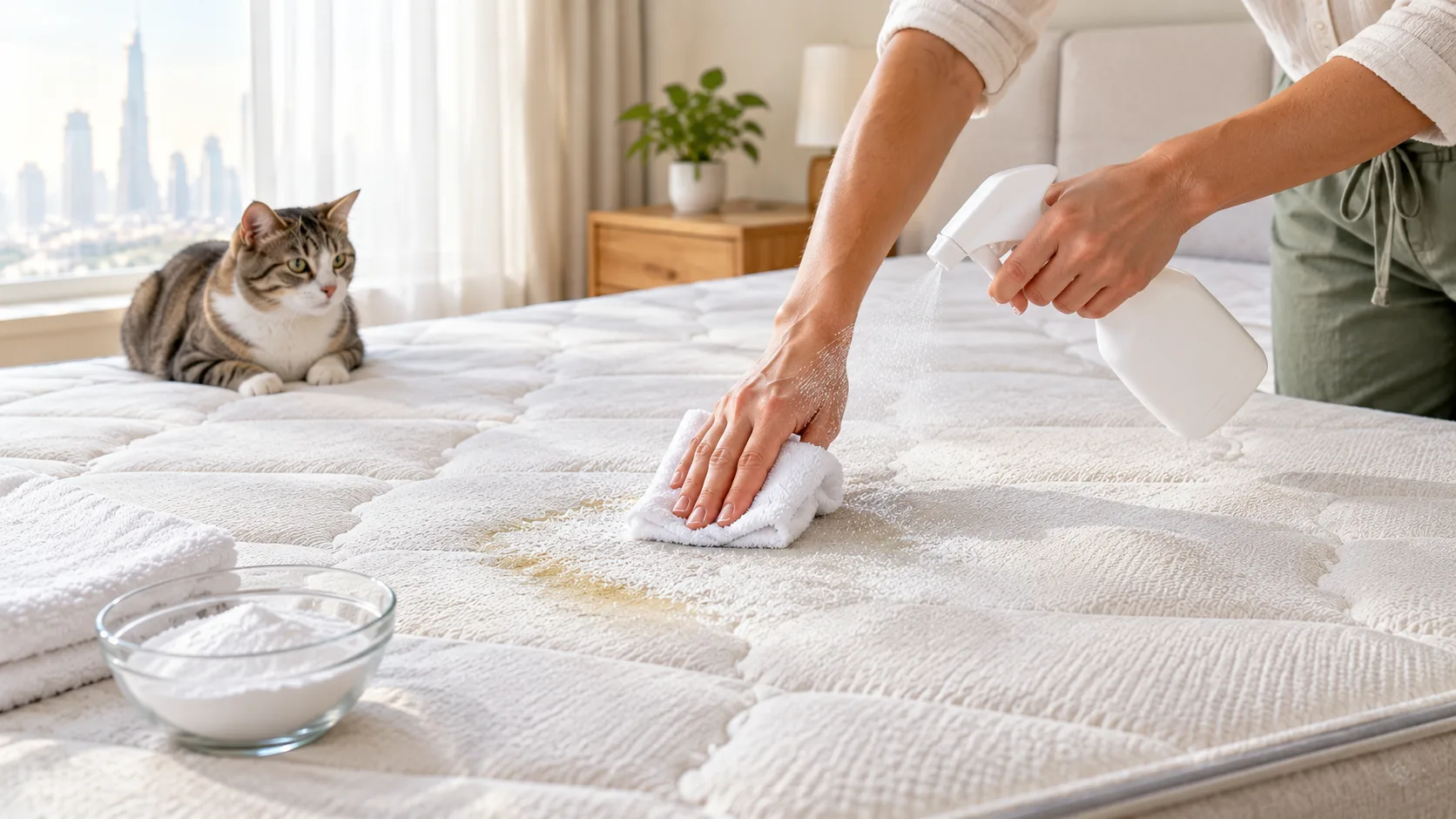
Cat urine deserves its own section because it is a genuinely harder problem than human urine, and the methods that work on everything else often fail on it.
Why cat pee smells so much worse
Cat urine is far more concentrated than human urine, because cats evolved in desert conditions and their kidneys are built to lose as little water as possible. It also contains felinine, a sulphur compound unique to cats. As it breaks down it releases thiols — the same family of compounds that makes skunk spray so penetrating.
On top of that, cat urine continues to decompose for weeks, releasing ammonia as it goes. That is why a cat accident often smells worse a fortnight later than it did on the day, and why it is still noticeable after a cleaning that would have dealt with anything else.
Step-by-step method for cat urine
- Blot every drop you can while it is still wet, exactly as in Step 2.
- Rinse the area very lightly with cool water and blot it dry again, to dilute what remains.
- Saturate the spot with an enzyme cleaner, not vinegar. Use enough to reach as deep as the urine went — this is the one stage where being generous is correct.
- Leave it for the full time on the label, usually fifteen minutes to an hour. The enzymes need contact time to work; wiping it off early wastes it.
- Blot, then cover in baking soda and leave for at least twenty-four hours.
- Vacuum thoroughly and check with your nose up close.
- Repeat the whole cycle if any trace remains. Two or three rounds on cat urine is completely normal.
How to get rid of cat pee smell on a mattress for good
The single most important point: only enzyme cleaners break down the compounds in cat urine. Vinegar neutralises some of the ammonia and helps, but it does not touch felinine or the thiols. Baking soda absorbs odour but removes nothing. Air freshener and fabric spray simply sit on top.
So if cat urine keeps coming back on your mattress, the usual reason is one of three things: no enzyme cleaner was used, not enough was used to reach the full depth of the stain, or it was wiped away before the enzymes had time to act.
Never use ammonia or bleach
Two hard rules, for different reasons.
Ammonia is a component of cat urine. Cleaning with it tells your cat this is a toileting spot, and they will almost certainly use it again. Several general-purpose household cleaners contain ammonia, so check the label.
Bleach must never be mixed with urine or with ammonia. The combination produces chloramine gas, which is genuinely dangerous in an enclosed bedroom. Bleach will also strip the colour from the mattress fabric and does nothing for the underlying odour.
Stopping your cat returning to the same spot
Removing the smell completely is most of the battle, because a cat returns to a place that still smells of urine even faintly — and their nose is far better than yours. If the behaviour continues after a thorough enzyme clean, it is worth a vet visit: urinating outside the litter tray is a common sign of a urinary tract infection or stress, not defiance.
In the meantime, keep the bedroom door shut, make sure the litter tray is clean and somewhere quiet, and consider a waterproof mattress protector so the next accident never reaches the mattress at all.
Dog Urine and Puppy Accidents
Dog urine sits between human and cat urine in difficulty. It is more concentrated than human urine and carries a stronger odour, but it does not contain felinine, so it responds well to the vinegar and baking soda method.
Use an enzyme cleaner anyway if you have one, particularly with an unneutered male dog or a repeat accident in the same spot. The same return-to-the-scent behaviour applies: a dog that can still smell urine treats the spot as marked.
If accidents have reached the carpet or a rug beside the bed as well, treat those at the same time, since an untreated patch of carpet will keep the room smelling even after the mattress is perfect. Heavily affected floor coverings usually need carpet and rug cleaning rather than a surface wipe.
Child Bedwetting: The Overnight Method
Bedwetting is common, it is not the child’s fault, and the practical problem is that it usually happens at 3am and the bed has to be usable again.
The fast version, in order:
- Strip the bed and put everything straight in the machine.
- Blot hard with dry towels until little comes up.
- Mist with the vinegar solution and blot again.
- Cover thickly in baking soda.
- Put a fan on it and sleep elsewhere for the night.
- Vacuum in the morning — the mattress will usually be fine.
If this is happening regularly, a waterproof mattress protector is not optional — it is the difference between washing a cover and treating a mattress. Buy two, so one is always clean while the other is in the wash, and take the one in use off and wash it hot after every accident.
Cleaning Different Mattress Types
The method is broadly the same, but how much moisture a mattress tolerates varies a lot.
Memory foam
The most sensitive and the easiest to ruin. Memory foam absorbs liquid readily and releases it very slowly, so use roughly half the liquid you would elsewhere and allow double the drying time. Never soak it, never put it in direct hot sun for long, and never steam clean it — heat degrades the foam structure permanently.
Latex
More water resistant than memory foam and more forgiving, but it must be kept out of prolonged direct sunlight, which breaks latex down. Keep the liquid light and dry it with a fan rather than sun.
Pillow-top and quilted
The padded top layer holds moisture and odour in the stitching, so these need more baking soda, longer dwell time and far more vacuuming than a flat mattress. Pay particular attention to the seams.
Spring and hybrid
The most tolerant of the four. Air passes through the spring core, so they dry fastest. The risk here is different: liquid that reaches the springs can cause rust over time, so still keep the moisture to a minimum.
What Never to Use on a Mattress
- Bleach — dangerous with urine, strips colour, does not remove odour.
- Ammonia — invites pets to use the same spot again.
- A steam cleaner — forces moisture deep into foam that cannot dry out, and can set protein stains permanently.
- Large volumes of water — a soaked core means mould, and mould ends a mattress.
- A hair dryer on hot — heat sets protein stains and can damage foam.
- Scrubbing brushes — they push the stain deeper and damage the ticking.
- Air freshener or fabric spray as a fix — it masks for an hour and adds residue.
Why Mattress Odours Are Harder to Clear in Dubai
If the same method worked for you somewhere else and is struggling here, the climate is a genuine factor.
- High humidity keeps uric acid crystals active, so odours that would stay dormant elsewhere keep releasing.
- Slow drying in humid air leaves mattresses damp for longer, which risks mould and mildew in the core.
- Constant air conditioning means bedrooms are often sealed, so odour accumulates instead of ventilating away.
- Fine dust settles into bedding and mattresses quickly, giving dust mites more to feed on.
- Heat accelerates bacterial breakdown, so an untreated accident develops a strong smell faster.
The practical takeaway is that drying is not an optional final step here, it is the step that determines the outcome. Always use a fan, and always run the AC.
When the Smell Will Not Come Out
Some mattresses are past home treatment, and it is worth recognising that before spending another weekend on it.
Signs that the problem is beyond a surface clean:
- You have treated it three times properly and the smell still returns.
- The urine soaked all the way through and is visible on the underside.
- There are multiple accidents over months across a wide area.
- There is a musty smell as well, which suggests mould in the core.
- Visible mould spotting anywhere on or under the mattress.
- Anyone sleeping on it has developed a cough, congestion or skin irritation.
The first four are usually solvable with professional equipment. Established mould in the core is not — at that point the mattress needs replacing, and the bed base and the room should be checked too.
Where urine has gone through to the base or the smell has spread beyond the bed, treating the room rather than the item is the sensible move, which is what home disinfection and sanitisation covers.
DIY or Professional Mattress Cleaning?
Home treatment handles most single accidents. The table below is the honest division.
| Situation | Home treatment | Professional cleaning |
|---|---|---|
| Fresh accident, caught quickly | Usually enough | Not needed |
| Dried stain, a few days old | Works with 2–3 rounds | Faster and more certain |
| Old stain, weeks or months | Odour yes, stain unlikely | Recommended |
| Cat urine | Possible with enzymes | Recommended |
| Repeated accidents, wide area | Rarely enough | Recommended |
| Soaked through to the base | No | Required |
| Musty or mouldy smell | No | Inspection, likely replacement |
| Allergies or asthma in the home | Partial | Recommended |
The difference is depth and extraction. Home methods treat the top layer and rely on evaporation. A professional mattress cleaning service injects solution and extracts it again under suction, pulling urine residue, dust mites and allergens out of the mattress rather than redistributing them — and it leaves the mattress far drier than any home attempt, which matters a great deal in this climate.
How to Protect Your Mattress From Now On
Prevention here is unusually effective, because one piece of equipment solves most of it.
- Use a waterproof mattress protector. The single best thing you can do. A protector that cost a little turns every future accident into a laundry task.
- Keep a spare protector so the bed can be remade immediately at night.
- Wash bedding weekly at the highest temperature the label allows.
- Air the mattress monthly — strip it, leave it uncovered for a few hours with the AC running.
- Vacuum the mattress when you change the sheets.
- Deal with accidents immediately, even at 3am. Ten minutes then saves a weekend later.
- Keep pets off the bed if there has already been one accident.
If dust mites or bites are part of the picture as well, note that those are a separate problem with a separate solution — a cleaning service removes allergens, while an actual infestation needs bed bug treatment.
How Often Should a Mattress Be Cleaned?
As a general guide in Dubai conditions: vacuum it monthly, deal with spills on the day, and have it professionally cleaned once or twice a year. Twice a year is the sensible choice for homes with young children, pets, allergy sufferers, or anyone who has had an accident on the mattress before.
Many households book it alongside a wider clean rather than as a standalone visit, which is how it usually appears within apartment deep cleaning. If the same accident reached the sofa — or you are dealing with upholstery odour more generally — the method differs by material, and we cover it separately in how to clean a couch at home, with professional sofa cleaning for anything that has soaked into the cushions.
How to Remove Urine Smell from a Mattress: The Short Version
If you take nothing else from this guide, take these points.
- The smell returns because of uric acid crystals, which water and soap do not dissolve.
- Blot, never rub, and never soak the mattress.
- Vinegar solution first, then a thick layer of baking soda for at least eight hours, then vacuum.
- For cat urine, skip the vinegar and use an enzyme cleaner — nothing else breaks it down.
- Never use bleach or ammonia on a mattress.
- Dry it completely with a fan and the AC running. In Dubai this step decides the result.
- Repeat the full cycle if any smell remains. Two or three rounds is normal.
When an accident is old, repeated, or has soaked through, home treatment has a real limit. Care N Clean provides professional mattress cleaning in Dubai using hot water extraction and sanitisation, which removes urine residue, odour and allergens from the depth of the mattress and leaves it dry enough to use the same day.